What is Backend? Server-Side Programming with Node.js, Express.js, and MongoDB
Modern web programming consists of two main areas: Frontend and Backend. While the Frontend is the part the user sees and interacts with, the Backend is the part running behind all these processes, managing data, and ensuring the system's functionality.
What is Backend?
The backend is the server-side part of websites and applications that is not directly visible to the user. Data storage, processing, user registration, security, and the system's business logic are managed through the Backend.
For example, on an e-commerce website, when a user adds a product to the cart, logs into their account, or places an order, managing all these operations in the background is the responsibility of the Backend.
Key Functions of the Backend
- Creating and managing the server;
- Establishing a connection with the database;
- Adding, deleting, and updating data;
- Building APIs;
- User registration and authentication;
- Ensuring data security;
- Establishing communication between the Frontend and the database.
What is Node.js?
Node.js is a runtime environment that allows the JavaScript programming language to run outside the browser, including on the server side.
Previously, JavaScript was mainly used in the browser. Thanks to Node.js, it is possible to build servers, APIs, and various Backend systems with JavaScript.
Node.js is not a programming language or a framework. It is an environment that enables JavaScript code to be executed.
Advantages of Node.js
- Using the same programming language for both Frontend and Backend;
- Support for asynchronous operations;
- Extensive NPM package ecosystem;
- Building real-time applications;
- Architecting modern and scalable systems.
Using Node.js, it is possible to build e-commerce platforms, chat applications, admin panels, and various server systems.
What is Express.js?
Express.js is a web framework running on top of Node.js that makes Backend programming simpler and more convenient.
Although it is possible to create a server directly with Node.js, Express.js simplifies server management, API development, and request processing.
What Can You Do with Express.js?
- Create a server;
- Build a REST API;
- Set up a routing system;
- Manage HTTP requests;
- Use middleware;
- Integrate with a database;
- Build authentication and authorization systems.
The most commonly used HTTP methods in Express.js are as follows:
MethodFunctionGETRetrieve dataPOSTCreate new dataPUTUpdate an existing resource completelyPATCHPartially update dataDELETEDelete data
Through these methods, CRUD (Create, Read, Update, Delete) operations are performed.
What is MongoDB?
MongoDB is a NoSQL database used for storing and managing data.
While data is stored in tables in traditional relational databases, MongoDB stores data in JSON-like BSON documents.
This structure is especially convenient for developers working with JavaScript.
Core Concepts of MongoDB
- Database — the database itself;
- Collection — a group where documents are stored;
- Document — an individual data object;
- Field — a data field inside a document;
- ObjectId — a unique identifier type frequently used for documents.
Using MongoDB, it is possible to store user data, products, orders, blog posts, and other information.
To work with MongoDB in Node.js projects, you can use the MongoDB Driver or the Mongoose library.
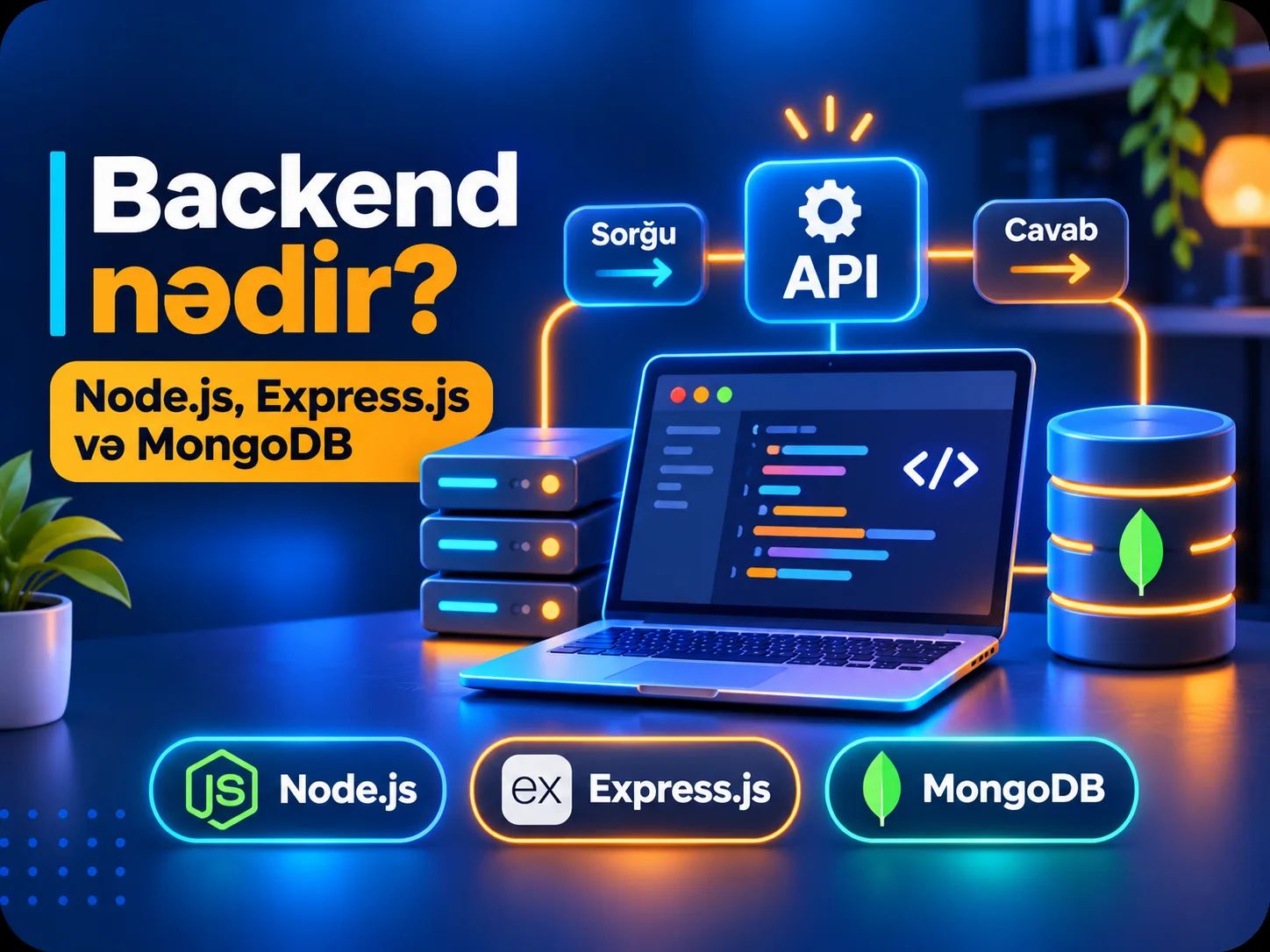
How Do Node.js, Express.js, and MongoDB Work Together?
These three technologies complement each other to enable the creation of a functional Backend system.
- Node.js — enables JavaScript code to run on the server.
- Express.js — manages the server, APIs, and HTTP requests.
- MongoDB — stores and manages data.
For example, when a user registers on a website, a request is sent from the Frontend to the server. Express.js receives that request, the program running in the Node.js environment validates the data and securely hashes the password. Then the data is stored in MongoDB, and the server returns the result of the operation to the user.
All of these processes happen in the background out of the user's sight.
What Do You Need to Learn to Become a Backend Developer?
For people who want to start Backend programming, it is advisable to learn the following topics step by step:
- JavaScript fundamentals and asynchronous programming
- Node.js and NPM
- Express.js
- HTTP and REST API
- Routes and Controllers
- Middleware
- MongoDB and Mongoose
- CRUD operations
- Data validation
- Authentication and Authorization
- JWT and password hashing
- Error Handling
- Environment Variables
- Git and GitHub
- Deployment
Conclusion
Backend programming is not just about creating a server and storing data in a database. It is the core system that ensures an application runs properly, securely, and reliably.
By learning Node.js, Express.js, and MongoDB, it is possible to build APIs for real-world projects, manage databases, and create functional web applications.
The Frontend shapes how an application looks, while the Backend forms its operating logic. A developer who masters both areas can build both the user interface and the system running behind it as a Full-Stack Developer.