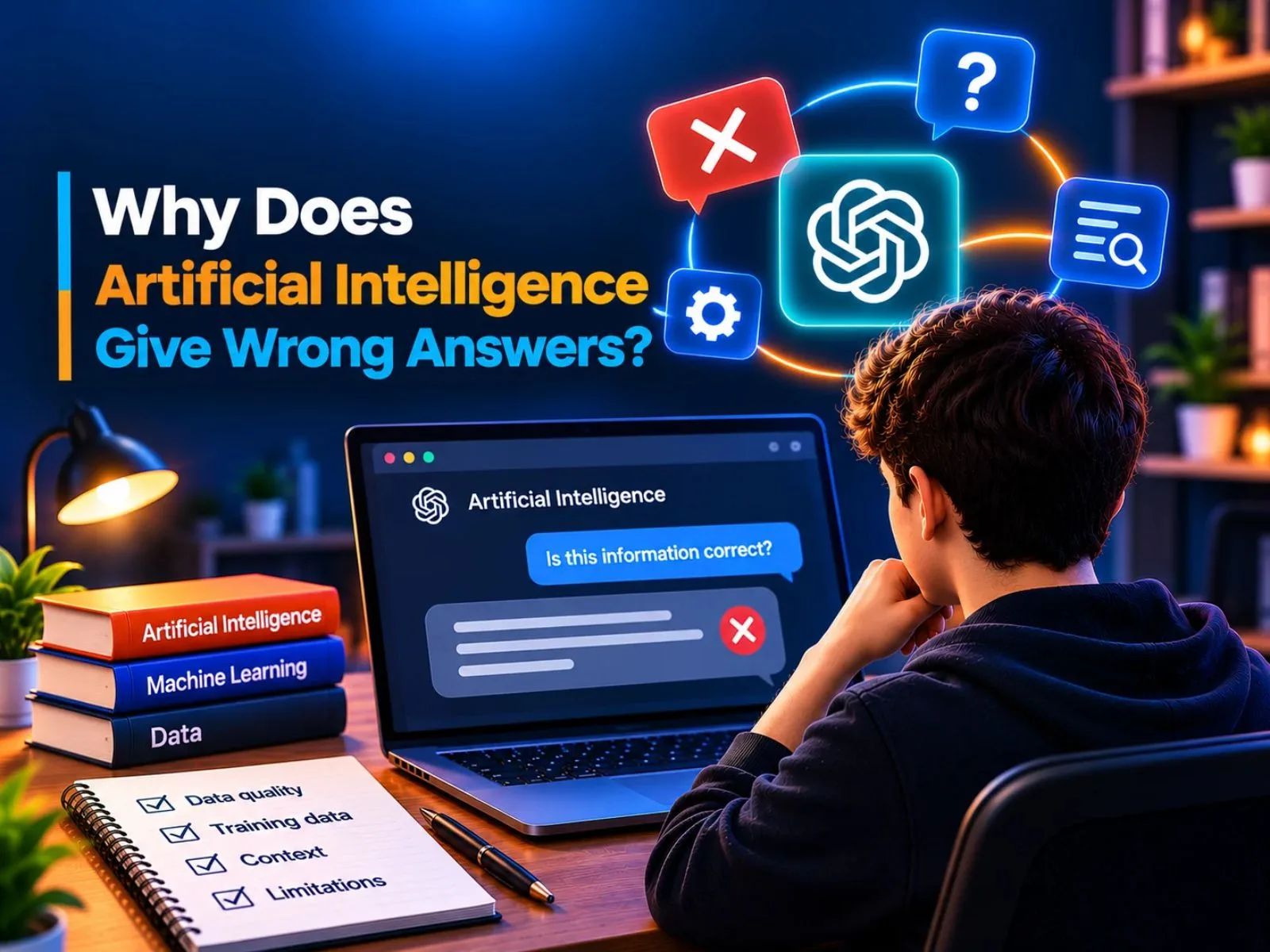
Why Does Artificial Intelligence Give Wrong Answers?
Artificial Intelligence tools can write text, summarize information, answer questions, and explain various topics within seconds. Because of this, users may sometimes confuse a fast and confident answer with an automatically correct one. However, Artificial Intelligence can also make mistakes, generate information that does not exist, or misunderstand the meaning of a question. So, why does Artificial Intelligence give wrong answers? The main reason is that Generative AI systems do not “know the truth” in the same way humans do. They try to generate the most appropriate response based on patterns they learned during training. In this article, we will explain the main causes of AI errors, the concept of “hallucination,” and ways to verify AI-generated answers more effectively.
How Does Artificial Intelligence Generate an Answer?
Large Language Models are trained on very large amounts of text. During this process, the model learns relationships between words, expressions, and concepts. When a user asks a question, the model generates an answer by selecting the next word or group of words based on probabilities and the given context. In other words, the model does not necessarily work like a traditional search engine or a factual database. Its main goal is to generate a response that appears relevant and logical for the given request. For this reason, an answer may sound highly convincing while still being factually incorrect. The risk of an incorrect result can increase especially when the topic is very specific, available information is limited, or the question is unclear.
What Is an AI Hallucination?
When Artificial Intelligence generates a fact, date, source, quotation, or other information that does not actually exist, this is commonly referred to as an AI hallucination. For example, the system may provide the name of a book, research paper, or website that looks real but does not actually exist. In other cases, it may combine correct information about a real person or event with incorrect details. A hallucination is slightly different from a regular mistake. In a simple error, the model may state an existing fact incorrectly. In a hallucination, the system may confidently generate information that does not exist at all. Therefore, the fact that an answer is well written does not guarantee that it is accurate.
Why Does Artificial Intelligence Give Wrong Answers?
There are several main reasons why AI systems can make mistakes.
The Information May Be Incomplete or Low Quality
Artificial Intelligence uses patterns from the information it was trained on. If that information contains errors, contradictions, or missing details, these issues may also affect the model's answers. Not all information on the internet is equally reliable. Outdated, incorrect, or contextually misleading information also exists. The model may not always evaluate these differences in the same way a human expert would.
The Question May Be Unclear
A question such as “What is the best software?” does not have one clear answer. It does not specify the purpose, budget, or type of user. The more ambiguous the prompt is, the more the model has to rely on different possibilities when generating an answer. For this reason, asking a precise question can help produce a more relevant response. For example, instead of asking:
“Is Python good?”
you can ask:
“Why is Python a suitable choice for someone starting to learn Artificial Intelligence?” This question is more specific and can lead to a more focused answer.
The Information May Be Outdated
Technology, laws, prices, company executives, product features, and other information can change over time. The knowledge available to a model may not always reflect the latest situation. For this reason, when asking questions that require current information, it is important to pay particular attention to dates and sources.
The Model May Misunderstand the Context
The same word can have different meanings in different fields. If the context is not clear enough, AI may interpret the question in a different way than the user intended. For example, the word “Java” may refer to a programming language or another concept. Clearly explaining the purpose of the question can reduce the risk of misunderstanding.
How Can You Get More Accurate Answers from AI?
It is not possible to completely eliminate the possibility of errors when using Artificial Intelligence. However, the risk can be reduced with the right approach. First, make your question specific. Explain the goal, context, and the format of the answer you want.
Instead of saying:
“Explain this topic.”
you can say:
“Explain this topic to a beginner using three simple examples.”
For answers involving factual information, ask for sources. Especially when dealing with dates, statistics, laws, medical information, financial indicators, and official rules, verify the answer using an independent source. Do not rely on a single AI answer when making important decisions. Compare the information with official sources, expert opinions, or reliable documents.
You can also ask follow-up questions about suspicious parts of an answer, such as:
“What is the source of this information?”
“Verify this fact.”
“Show separately which parts you are not certain about.”
When Should You Be Especially Careful with AI-Generated Answers?
In some areas, even a small mistake can lead to serious consequences.
For this reason, AI-generated answers should not be treated as the final decision in areas such as:
- medical diagnosis and treatment;
- legal advice and laws;
- financial and investment decisions;
- official dates, rules, and payments;
- sources and quotations in academic research;
- technical decisions related to security.
In these areas, Artificial Intelligence can be useful for providing an initial explanation or direction, but the final information should be verified using a reliable source.
Frequently Asked Questions
Does Artificial Intelligence Intentionally Give False Information?
No. The model's purpose is not to deceive the user. Incorrect answers may result from the way the model processes information and generates responses.
How Can You Identify an AI Hallucination?
Check suspicious facts, dates, numbers, and sources separately. If the system provides a website, book, article, or quotation that does not exist, this may indicate an AI hallucination.
Do All AI Answers Need to Be Verified?
Not always for simple creative tasks. However, verification is important when the information is fact-based or may affect a decision.
Does a Longer Prompt Always Produce a More Accurate Answer?
No. The most important factor is not the length of the prompt, but its clarity. A long prompt filled with unnecessary details can also create confusion.
Is It Possible to Completely Prevent AI Errors?
Not completely at the moment. Better models, clearer context, reliable data sources, and human review can reduce errors, but they cannot eliminate the risk entirely.
Conclusion
Artificial Intelligence is a fast and useful tool, but its answers should not automatically be considered correct. Generative AI systems do not work simply as factual databases. They generate responses based on patterns learned during training. For this reason, incomplete information, unclear questions, outdated knowledge, and misunderstood context can lead to incorrect results. To use Artificial Intelligence more effectively, ask specific questions, verify important facts using reliable sources, and avoid using AI as the only source of information, especially for medical, legal, financial, and official matters. The most effective approach is to use Artificial Intelligence not as a “system that is always correct,” but as an intelligent assistant that helps you understand information and work more efficiently.
If you want to learn more about how Artificial Intelligence works, why it can generate incorrect answers, and the technologies behind AI systems, the AI Engineering Course at JET Academy can be a suitable starting point for you.
For detailed information and registration, visit the following link: https://jetacademy.az/en/courses/ai-engineering-course