What Is Vibe Coding and What Is It Used For?
In the past, developing software mainly required learning the syntax of a programming language, writing code line by line, and manually finding and fixing errors. With the development of Artificial Intelligence tools, this process has started to change. Today, a user can describe the software they want to build in natural language, and Artificial Intelligence can generate code based on that description. This approach has recently become known as vibe coding. So, what is vibe coding, how does it work, and when is it useful? Can someone without programming knowledge build a website or application using this method? In this article, we will explain these questions in simple terms.
What Is Vibe Coding?
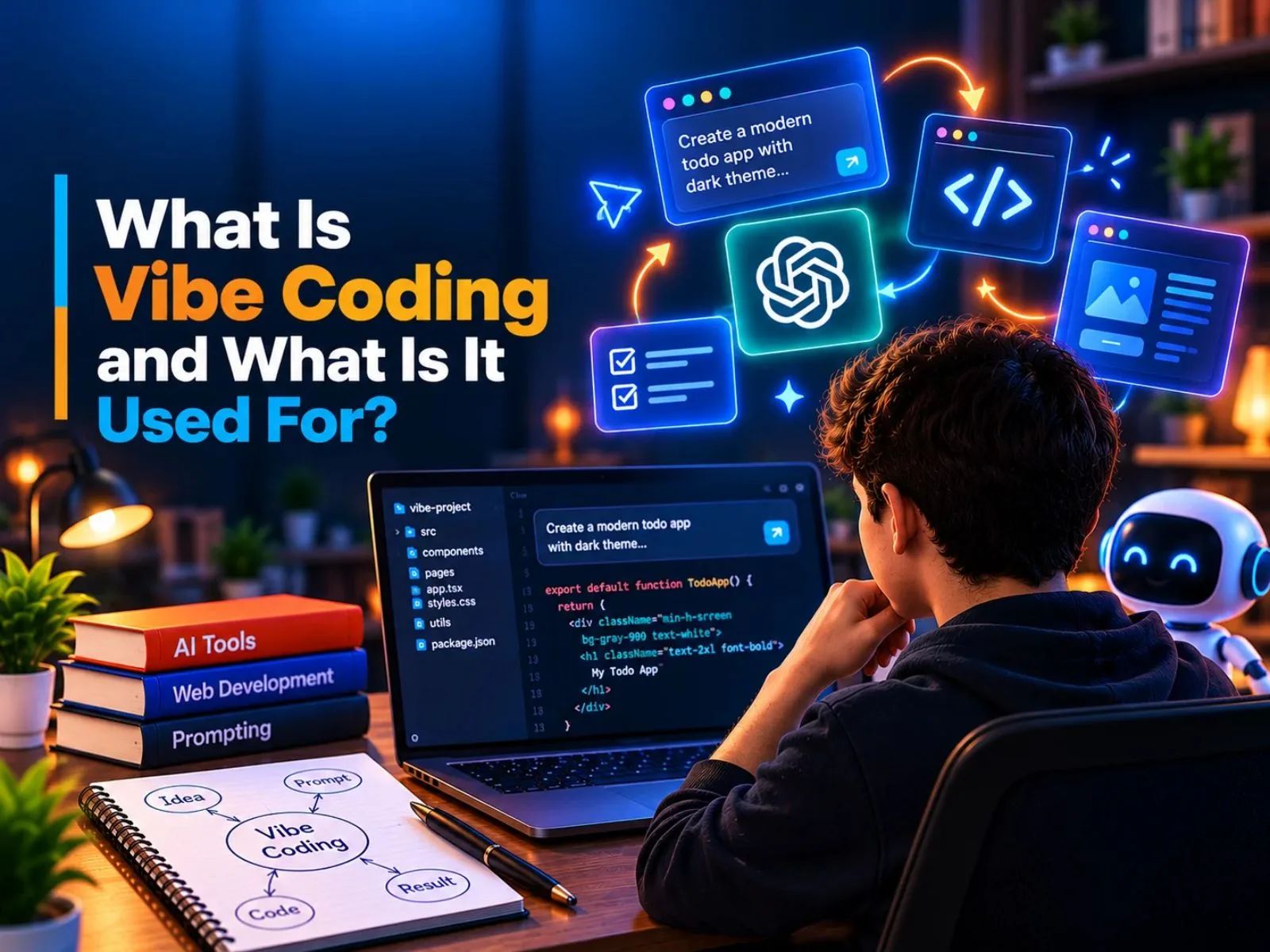
Vibe coding is a programming approach in which the user mainly describes the functionality they want to Artificial Intelligence in natural language instead of writing most of the code themselves.
For example, a user may give the following instruction:
“Create a simple registration form where users can enter their name and email address.”
Artificial Intelligence can then generate code in HTML, CSS, JavaScript, or another programming language based on this request.
The user reviews the result and asks for further changes with new instructions, such as:
“Move the button lower,” “Make it mobile-friendly,” or “Add a password field to the form.”
In this way, the software development process becomes less about manually writing code and more like having a dialogue with Artificial Intelligence. The term “vibe coding” was used by AI researcher Andrej Karpathy in February 2025. Initially, the term described a more relaxed programming approach that relied heavily on AI-generated results without deeply reviewing the code. Later, the concept began to be used more broadly to describe building software through natural language instructions with AI.
How Does Vibe Coding Work?
The core of the vibe coding process is the prompt, meaning the instruction given to the Artificial Intelligence system.
A typical process looks like this:
- The user describes the product they want to create.
- Artificial Intelligence generates the initial code.
- The result is run and tested.
- If there is a problem or a requested change, the user gives AI a new instruction.
- The code is updated and the process is repeated.
For example, an initial project can be created with the instruction:
“Build a simple expense tracking application.”
The project can then be gradually improved with additional requests such as:
“Show total monthly expenses,” “Add categories,” or “Display the data in a chart.”
While traditional programming focuses more on how the code is written, vibe coding focuses more on what the final result should look like and do.
What Is Vibe Coding Used For?
Vibe coding can be especially useful when an idea needs to be tested quickly.
Creating Prototypes
If you have a new product idea, you can build a working prototype before developing the complete software. For example, if a startup wants to test a new service idea, it may use AI to create an initial version more quickly.
Creating Simple Websites and Applications
Landing pages, portfolios, simple calculators, registration forms, dashboards, and small internal tools can be created with vibe coding.
Generating Repetitive Code
Developers can also benefit from this approach. Instead of manually writing the same structures repeatedly, Artificial Intelligence can generate the initial code. This allows developers to spend more time on system logic, architecture, and problem solving.
Testing New Ideas
Sometimes you do not need to build a complete product to determine whether an idea works. Vibe coding makes it possible to create a working example quickly and test the idea in practice.
What Are the Advantages of Vibe Coding?
One of the main advantages is speed. For simple projects, AI can generate an initial code structure within minutes. Another advantage is that it lowers the entry barrier. People who do not have professional-level programming knowledge can also try to turn their ideas into initial products.
Vibe coding can also help with:
- creating prototypes faster;
- reducing repetitive tasks;
- testing ideas more easily;
- allowing developers to focus more on product logic.
However, fast results do not always mean high-quality software.
Are There Any Risks to Vibe Coding?
Yes. One of the most important points is that AI-generated code is not always correct, secure, or optimized. The code may appear to work, but it may contain security vulnerabilities, unnecessary sections, or structural problems that can cause difficulties later. If the user accepts every AI-generated change without understanding the code, solving problems can become increasingly difficult as the project grows. Expert sources also highlight that, despite the speed and accessibility benefits of vibe coding, there are risks related to security, code quality, and long-term maintainability. For this reason, in projects that store real user data, accept payments, or interact with a company's core systems, AI-generated code should be reviewed by a qualified specialist.
Does Vibe Coding Make Programming Knowledge Unnecessary?
No. Vibe coding can lower the barrier to entering software development, but programming knowledge remains a major advantage when building complex and reliable products. A person who understands concepts such as HTML, CSS, JavaScript, Python, databases, and APIs can more easily evaluate whether AI-generated code is correct. In other words, Artificial Intelligence can speed up the coding process, but it does not completely remove the need to understand how software works. In professional projects, testing, security reviews, and human oversight are still important.
Frequently Asked Questions
Do You Need Programming Knowledge for Vibe Coding?
Not necessarily for simple prototypes. However, programming knowledge is very helpful when building more complex and real-world projects because it allows you to review results and solve problems more effectively.
Can You Build a Website with Vibe Coding?
Yes. Landing pages, portfolios, registration pages, and various simple web applications can be created using vibe coding.
Is Vibe Coding Safe?
It depends on the project. If AI-generated code is used without review, security and code quality issues may occur. Especially in commercial projects, the code should be reviewed and tested.
Will Vibe Coding Replace Developers?
With the current approach, vibe coding is more likely to change the way software is developed rather than completely replace developers. Human expertise is still needed for architecture, security, testing, technical decision-making, and solving complex problems.
Are Vibe Coding and AI Coding the Same Thing?
Not exactly.
AI coding is a broader concept and can include any situation where a developer uses Artificial Intelligence as a coding assistant.
Vibe coding, on the other hand, is more specifically based on building software through natural language instructions and delegating much of the code generation process to AI.
Conclusion
Vibe coding is one of the new approaches that Artificial Intelligence has introduced to the software development process. The user explains what they want to create, AI generates the code, and the code is then modified based on additional instructions. This method can be especially useful for building prototypes, simple applications, and testing new ideas. However, accepting AI-generated code without reviewing it is not the best approach. To get the most value from vibe coding, it is better to use it not as a replacement for programming, but as an AI tool that speeds up the software development process. Learning the fundamentals of programming will also help you manage and evaluate AI-generated results more effectively.
If you want to learn more about vibe coding, AI-assisted programming, and modern software development tools, the Full-Stack Programming Course at JET Academy can be a suitable starting point. Along with programming fundamentals, you can also develop your skills in working with modern technologies and AI tools.
For detailed information and registration, visit JET Academy's Full-Stack Programming Course page.